How to Select Metals for Minimally Invasive Surgery Tools

Time:2026-10-07 Author:Isabella
0%

Choosing the right metal can determine whether a minimally invasive instrument feels precise or frustrating in the surgeon’s hand. The decision affects strength, flexibility, corrosion resistance, sterilization, and patient safety. This guide explains How to select metals for minimally invasive surgery tools through practical engineering considerations and evidence-based evaluation.

Material selection often begins with the instrument’s job. A grasper may need repeated flexing, while a cutting tip requires hardness and edge stability. Stainless steel offers durability, familiar processing methods, and strong corrosion resistance. Titanium reduces weight and supports excellent biocompatibility. Nitinol provides useful elasticity for steerable or expandable components. Cobalt-chromium alloys can deliver high wear resistance, but machining them may require greater control.

Small details matter. Consider a shaft passing through a narrow trocar, where friction can affect movement. Examine joints under repeated opening cycles. Check whether cleaning chemicals, steam, or low-temperature sterilization could damage surfaces. Supplier certificates, traceability records, and material testing should support every important choice. Relevant ASTM and ISO requirements can help structure verification, but they do not replace product-specific testing.

There is no universal best metal. That assumption can mislead teams. Early prototypes may expose weaknesses that laboratory data misses. A polished surface can still create unwanted drag. A strong alloy may add unnecessary weight. Engineers, surgeons, quality specialists, and manufacturers should review these trade-offs together. The final decision should reflect clinical use, manufacturing capability, validated cleaning processes, and documented safety evidence. Careful selection is slower at the beginning, but it can prevent costly redesigns and unreliable performance later.
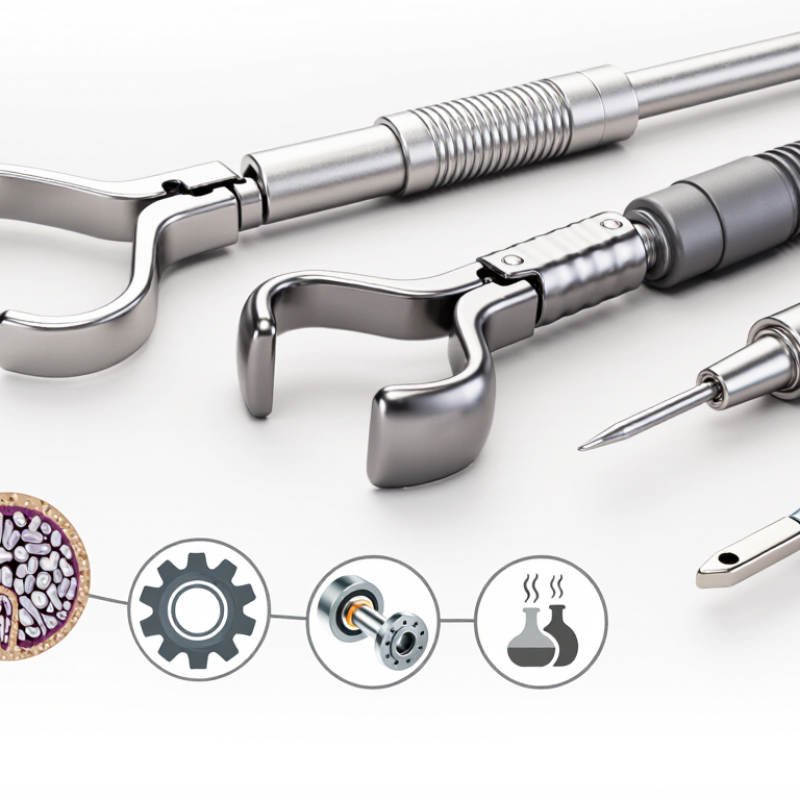
How to Select Metals for Minimally Invasive Surgery Tools

Defining Performance Requirements for Minimally Invasive Surgical Tools

How to Select Metals for Minimally Invasive Surgery Tools

Defining performance requirements should come before choosing a metal. A laparoscopic grasper needs controlled stiffness, reliable jaw alignment, and smooth force transmission. A guidewire needs flexibility, fatigue resistance, and predictable recovery after bending. These requirements differ sharply. One alloy cannot solve every design problem.

In practical tool development, engineers often begin with the surgeon’s hand movements. They measure shaft deflection, tip force, grip response, and repeated actuation cycles. Stainless steel may provide strength and familiar processing. Nickel-titanium can offer elastic recovery for flexible components. Titanium may reduce weight and support corrosion resistance. Material selection also requires checking sterilization exposure, surface finish, wear debris, and contact with tissue or fluids. Small scratches can become meaningful failure points.

Testing must reflect real use, not only neat laboratory samples. A tool may pass tensile testing yet feel vague through a long, narrow shaft. It may survive static loading but fail after thousands of angled movements. That gap deserves attention. A performance specification can still be wrong. Engineers should compare bench data with simulated procedures and documented clinician feedback. They should also review manufacturing variation, because thin parts rarely behave exactly like their drawings suggest. Clear acceptance limits make later validation more reliable. Safety depends on evidence, traceable decisions, and honest review of what remains uncertain.

Comparing Metals for Strength, Flexibility, and Corrosion Resistance

How to Select Metals for Minimally Invasive Surgery Tools

Metal selection depends on the tool’s job, not appearance. A biopsy forceps needs controlled flexibility and reliable fatigue resistance. A cutting component needs hardness, edge stability, and enough strength under repeated loading. Stainless steel often provides a practical balance for shafts and handles. Nickel-titanium offers exceptional flexibility and shape recovery, but it requires careful processing and inspection. Titanium is lightweight and corrosion resistant, although its lower stiffness may affect thin, force-bearing parts.

Corrosion resistance matters in saline fluids, cleaning solutions, and repeated sterilization cycles. Even a strong alloy can fail if surface damage creates small corrosion sites. Evaluate tensile strength, yield strength, bending behavior, and fatigue life together. Test finished components, not only raw material samples. Our early selections sometimes focused too heavily on hardness. That was a mistake. A harder metal may increase wear resistance but reduce flexibility or complicate manufacturing. The final choice should match the instrument’s dimensions, contact forces, and expected service life.

Tips: Compare metals using simulated body fluids and realistic sterilization cycles. Inspect joints, edges, and laser-cut areas closely. Ask for traceable material certificates and test data. Small defects matter. Also, review the design after testing, because the best material cannot correct an unsuitable geometry.

How to Select Metals for Minimally Invasive Surgery Tools

This comparison uses representative medical-grade material values. Strength is shown as approximate yield or tensile strength, flexibility as elongation or recoverable strain, and corrosion resistance as a qualitative rating from 1 to 5. Actual performance varies with alloy grade, heat treatment, surface finish, and tool design.

Assessing Biocompatibility and Sterilization Compatibility

How to Select Metals for Minimally Invasive Surgery Tools

Biocompatibility begins with the patient’s actual exposure, not the metal’s reputation. A tool may contact blood, tissue, saline, or a polymer coating. Each contact can change the risk profile. Stainless steel often offers strong corrosion resistance and practical machinability. Titanium reduces weight and usually performs well in biological environments. Cobalt-chromium alloys can provide hardness under repeated mechanical stress. However, nickel release deserves careful attention in sensitive applications. Small quantities can matter.

Surface condition is equally important. Scratches, trapped residues, and poor passivation may create sites for corrosion. A smooth finish also supports cleaning before sterilization. Yet smooth does not mean automatically safe. Testing should examine corrosion, extractables, cytotoxicity, sensitization, and irritation. Relevant biological evaluation should follow a risk-based process, such as ISO 10993 guidance. Material certificates and supplier traceability strengthen reliability.

Sterilization compatibility must be assessed with the finished instrument. Repeated steam cycles can expose weak joints, dissimilar-metal contacts, and protective surfaces. Low-temperature methods may affect adhesives, coatings, or polymer inserts. Galvanic corrosion can occur when different metals meet in moisture. That detail is easy to miss. Validation should include the expected number of cycles, not one laboratory run. A useful review records changes in mass, color, surface roughness, function, and microbial barrier performance. No material choice is perfect. Teams should document uncertainty, challenge optimistic assumptions, and revisit the design when cleaning methods change.

Matching Metal Properties to Specific Surgical Tool Components

Minimally invasive tools need metals matched to their working parts, not selected by reputation alone. A 2024 Grand View Research analysis estimated the global minimally invasive surgical instruments market at over USD 23 billion. That growth increases pressure to balance strength, cleanliness, and manufacturing cost.

For a trocar shaft, precipitation-hardening stainless steel offers high strength and corrosion resistance. Its rigid wall helps maintain a stable access path. Needle tips need hardness and sharp edge retention, so hardened stainless steel is often more suitable. However, excessive hardness may make a fine tip brittle. Small errors matter.

Grasping jaws face repeated opening, closing, and sterilization cycles. Nickel-rich stainless steel can provide useful fatigue resistance and passive corrosion protection. For flexible endoscopic components, cobalt-chromium alloys may offer high stiffness in thin sections. Their higher density can still affect handling. That trade-off deserves testing.

Titanium alloys reduce weight and generally resist body-fluid corrosion, making them attractive for slender shafts and articulated parts. Yet titanium can gall against titanium during sliding contact. A dissimilar-metal pairing or suitable surface treatment may be necessary. ISO 7153-1 and ASTM F899 provide recognized guidance for surgical instrument materials, but neither standard replaces component-level validation.

In practice, I would test the assembled tool after repeated sterilization, not only the raw metal. Tensile data can look excellent on paper. Hinge wear may tell another story. A 2023 materials review in the Journal of Biomedical Materials Research also highlights how surface finish influences corrosion and tissue-contact performance. The selection is never perfectly clean. Recheck the assumptions.

How to Select Metals for Minimally Invasive Surgery Tools — Matching Metal Properties to Specific Surgical Tool Components
Metal or Alloy Approximate Density Key Properties Recommended Tool Components Why It Fits the Component Important Limitations
Austenitic Stainless Steel
316L / 316LVM
Approximately 7.9–8.0 g/cm³ Excellent general corrosion resistance; good toughness; non-hardening by heat treatment; relatively low magnetic response; suitable for precision machining and electropolishing. Cannula shafts, trocar components, grasping jaws, scissors, clips, biopsy forceps, and general instrument frames Provides a balanced combination of corrosion resistance, manufacturability, toughness, and cost for components exposed to sterilization cycles and bodily fluids. Lower hardness and wear resistance than hardened martensitic stainless steels; may not be ideal for very sharp cutting edges or highly wear-loaded pivots.
Martensitic Stainless Steel
420 / 440A–440C
Approximately 7.7–7.8 g/cm³ Can be heat-treated to achieve high hardness, strength, and edge retention; suitable for wear-resistant cutting surfaces. Scissor blades, cutting jaws, needle holders, ratchets, and wear-resistant pivot parts High hardness supports durable cutting edges and resistance to indentation or abrasive wear in mechanical contact areas. Corrosion resistance generally decreases as hardness and carbon content increase; requires controlled heat treatment, passivation, and careful surface finishing.
Cobalt–Chromium Alloy Approximately 8.3–9.2 g/cm³ Very high wear resistance, strength, hardness, and corrosion resistance; retains mechanical performance under repeated loading. High-load jaw inserts, cutting edges, wear pads, hinge surfaces, and compact components requiring long service life Well suited to small contact areas subjected to repeated force, friction, and deformation where stainless steel may wear more quickly. Higher density and machining difficulty; comparatively high stiffness can increase local contact stresses; may be more difficult to form into intricate thin sections.
Titanium Alloy
Ti-6Al-4V
Approximately 4.4–4.5 g/cm³ Low density, high specific strength, excellent corrosion resistance, and relatively low magnetic susceptibility; elastic modulus is lower than that of steel. Lightweight laparoscopic shafts, articulating links, robotic instrument structures, handles, and minimally invasive tool bodies Reduces instrument weight while maintaining structural strength, which can improve handling and reduce fatigue during long procedures. Lower surface hardness and galling resistance than hardened steels; titanium-to-titanium sliding contact should be avoided or engineered with suitable coatings, bearings, or dissimilar materials.
Commercially Pure Titanium
Grades 2–4
Approximately 4.5 g/cm³ Excellent corrosion resistance, low density, good biocompatibility, and lower strength than Ti-6Al-4V; readily available in sheet, tube, and machined forms. Thin-walled cannulas, protective sleeves, lightweight tubes, and components requiring corrosion resistance with moderate mechanical loads Useful when low mass, chemical stability, and formability are more important than maximum strength or wear resistance. Not preferred for highly loaded jaws, cutting edges, or sliding interfaces because of its lower strength and hardness.
Nickel–Titanium
Nitinol
Approximately 6.4–6.5 g/cm³ Shape-memory behavior and superelasticity; can tolerate substantial elastic deformation and return toward a programmed shape. Steerable guide elements, flexible retrieval baskets, expandable frames, atraumatic loops, and deployable minimally invasive mechanisms Enables flexible components to pass through narrow anatomical pathways and recover their shape after bending or deployment. Transformation temperatures and fatigue performance must be tightly controlled; nickel release, surface condition, joining, and sterilization compatibility require specific validation.
Precipitation-Hardening Stainless Steel
17-4 PH
Approximately 7.7–7.8 g/cm³ High strength and hardness after aging treatment; good dimensional stability and useful corrosion resistance in properly processed conditions. Compact hinges, locking mechanisms, shafts, actuator parts, and structural components exposed to high mechanical loads Provides higher strength than annealed 316L while retaining a stainless-steel manufacturing route suitable for precision components. Corrosion resistance depends on heat-treatment condition and surface finish; less suitable than 316L for some highly aggressive environments or welded thin sections.
Tungsten Alloy or Cemented Tungsten Carbide Approximately 14–19 g/cm³, depending on composition Extremely high hardness, stiffness, density, and wear resistance; tungsten carbide is particularly effective against abrasive wear. Very small wear inserts, counterweights, dense distal elements, and specialized cutting or gripping inserts Appropriate when maximum wear resistance or a compact high-density element is required in a small component. High density increases instrument weight; some grades are brittle or difficult to machine; use requires careful retention and impact-load design.
Material-selection note: Property values are representative ranges and vary with alloy grade, heat treatment, cold work, manufacturing route, surface finish, and test method. Final selection should also verify sterilization resistance, fatigue life, galvanic compatibility, surface cleanliness, joining methods, and applicable medical-device requirements.

Validating Metal Selection Through Testing and Regulatory Review

How to Select Metals for Minimally Invasive Surgery Tools

Metal selection must be validated, not assumed. A useful candidate should withstand repeated bending, torsion, cleaning, and sterilization. Stainless steel may offer strength and corrosion resistance. Titanium can reduce weight. Nitinol may support flexible, shape-changing components. Each choice creates different risks. A thin grasper jaw can crack at its hinge after repeated cycles, even when it passes a simple strength test. That detail matters.

Testing should reflect real clinical use. Engineers can combine tensile testing, fatigue cycling, corrosion exposure, surface inspection, and simulated sterilization. Test samples should include finished tools, welds, coatings, and moving joints. Biological evaluation should address patient contact and processing conditions, using recognized methods such as ISO 10993 where applicable. Results need clear acceptance criteria, traceable records, and documented deviations. No test plan is perfect. Early assumptions may need revision.

Tips: Build a risk-based test matrix. Compare metal performance after cleaning and sterilization, not only when new. Inspect microscopic damage around hinges and laser-cut edges. Ask an independent reviewer to challenge the evidence. Regulatory review should connect every material decision to intended use, test data, manufacturing controls, and labeling. If evidence is incomplete, state the limitation plainly. That honesty strengthens the technical file.

FAQS

How should metal selection begin for minimally invasive tools?

Start with the tool’s function, dimensions, and contact forces. A biopsy forceps needs controlled flexibility and fatigue resistance. Looks can mislead.

Which metals may suit flexible components?

Nickel-titanium provides strong flexibility and shape recovery. It needs careful processing and inspection. Titanium is lighter but less stiff in thin, loaded parts.

When is stainless steel a practical choice?

Stainless steel often balances strength, corrosion resistance, machinability, and cost. It can suit shafts and handles. Its performance still depends on surface condition.

Why should corrosion testing use realistic conditions?

Tools may contact saline, cleaning solutions, and repeated steam cycles. Test samples should reproduce those conditions. Small scratches can become corrosion sites.

What properties should engineers compare together?

Compare tensile strength, yield strength, bending behavior, hardness, and fatigue life. A very hard metal may wear well but reduce flexibility. That trade-off is easy to miss.

Why must finished instruments be tested?

Raw material data cannot reveal weak joints, laser-cut edges, or assembly defects. Inspect the completed tool after testing. Small defects matter.

How should biocompatibility evaluation be planned?

Consider exposure to blood, tissue, saline, coatings, and residues. Evaluate corrosion, extractables, cytotoxicity, sensitization, and irritation. Nickel release deserves careful attention.

What should sterilization validation include?

Use the expected number of sterilization cycles, not one laboratory run. Check joints, coatings, adhesives, inserts, and dissimilar-metal contacts. Record color, mass, roughness, and function.

What selection mistake should teams openly review?

We once focused too heavily on hardness. That choice was incomplete. The design later required better flexibility and easier manufacturing. Revisit geometry after testing.

Conclusion

Selecting the right metal is essential to the safety, reliability, and performance of minimally invasive surgical instruments. How to select metals for minimally invasive surgery tools begins with defining the tool’s functional requirements, including strength, flexibility, fatigue resistance, dimensional stability, and corrosion resistance. Different components may require different material characteristics: shafts and cutting elements often need high strength and wear resistance, while guide wires, hinges, and articulating parts may benefit from controlled flexibility and fatigue durability.

Material selection must also consider biocompatibility, cleanability, and compatibility with repeated sterilization cycles. Metals should resist corrosion, surface degradation, and contamination under expected clinical conditions. After candidate materials are identified, manufacturers should match their properties to specific components and verify performance through mechanical, corrosion, sterilization, and simulated-use testing. Final decisions should be supported by documented risk assessment, quality controls, and applicable regulatory review to ensure the finished instrument performs consistently and safely throughout its intended service life.

Isabella

Isabella

Isabella is a dedicated marketing professional with a sharp focus on driving brand growth and engagement through strategic content creation. With an extensive background in digital marketing, she combines her passion for storytelling with her keen understanding of industry trends to deliver......