Choosing a metal for a medical device is not a simple popularity contest. China’s top ten metals may offer a useful starting point, but a ranking alone cannot establish whether any metal is suitable for contact with the human body. The real question is: How to evaluate bio-compatibility of metals under the conditions in which they will actually be used?
David F. Williams, a leading biomaterials scientist, defined a biomaterial as “a material intended to interface with biological systems to evaluate, treat, augment or replace any tissue, organ or function of the body.” That definition points to the central issue: performance depends on the interface. A polished implant, a scratched surface, and a metal releasing ions into surrounding fluid may behave differently. Small details matter.
A careful evaluation considers composition, surface condition, corrosion, wear, and the duration and type of tissue contact. Testing may examine cell response, inflammation, and substances released from the material. Results should be interpreted alongside the device’s design and intended use, not treated as a universal safety stamp. That distinction is easy to overlook.
This guide compares commonly discussed metals through those practical criteria. It also highlights where evidence is limited, because a confident ranking can hide important uncertainty. No single test tells the whole story. The aim is a clearer, evidence-led way to compare materials before making design or sourcing decisions.
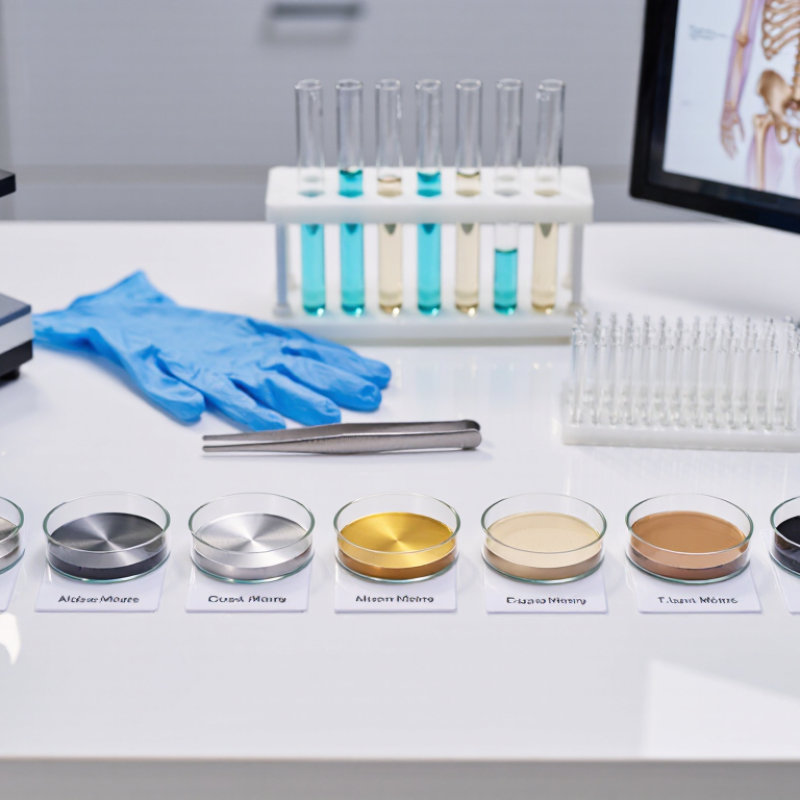
China’s medical-material supply chain commonly works with commercially pure titanium, titanium alloys, 316L stainless steel, cobalt-chromium alloys, tantalum, niobium, zirconium, magnesium alloys, gold, and platinum. These materials serve different roles: titanium and cobalt-chromium alloys appear in load-bearing implants, while tantalum can support porous bone-contact structures. Stainless steel is used in instruments and some implants. Gold and platinum are more common in specialized dental or electronic components. Magnesium alloys are being studied for devices designed to gradually degrade in the body. These are not interchangeable choices.
Biocompatibility depends on more than a metal’s name. Check exact composition, trace impurities, corrosion behavior, surface finish, and intended contact duration. A polished sample may behave differently from a porous or coated part. Testing should match the finished device and relevant biological risks, with documented methods and traceable material records. “Medical grade” alone proves little. Even familiar alloys can release ions under certain conditions, so results need careful interpretation. This part is easy to overlook.
Tips
Ask for composition and test reports for the actual production lot. Compare results with the device’s contact type and use conditions. If evidence is missing, pause and investigate. A material’s reputation is not a substitute for device-specific evaluation.
Metal composition matters because the body responds to released ions, not merely the alloy’s name. Nickel and cobalt can trigger sensitivity in some people, while corrosion may increase ion release. In titanium alloys, a thin, stable oxide layer helps limit contact between the underlying metal and tissue. But “biocompatible” is not a permanent property. Scratches, wear, and cleaning residues can change the surface.
Surface finish changes how fluids and cells meet a device. Roughness may support bone attachment in some implant designs, yet pits can also trap residues or encourage localized corrosion. The European Chemicals Agency reports nickel-release limits of 0.2 µg/cm² per week for piercing posts and 0.5 µg/cm² per week for prolonged skin-contact articles. These are specific consumer-product limits, not universal implant pass criteria. Still, they show why measuring release matters.
The U.S. FDA’s 2023 guidance frames biological evaluation around ISO 10993-1 and the device’s contact type and duration. Chemical characterization under ISO 10993-18 can help identify substances that may migrate from a material. A polished sample may look reassuring, but appearance alone tells little about ion release. Test the finished device, including coatings and joins. Real use is messier than a clean laboratory coupon.
Metal biocompatibility depends on how a part is made and used, not just its alloy name. A polished sample and a rough, corroded surface may interact differently with tissue. Testing should reflect the finished product, including coatings, cleaning residues, and surface condition.
Laboratories commonly assess cytotoxicity, sensitization, and irritation using methods selected for the intended contact. Cytotoxicity tests expose cultured cells to the material or its extracts and check for changes in cell health. Sensitization and irritation tests examine potential immune or local tissue responses. No single test tells the whole story. The ISO 10993 framework can help guide test selection, but it does not make every test appropriate for every device.
For long-term contact, teams may also examine chemical composition, corrosion, and metal-ion release in relevant fluids. A lab can compare results with controls and document sample preparation, exposure conditions, and test limits. Those details matter. This step is easy to underestimate. A result from one specimen may not represent every production batch, especially when surface finishing varies. Reviewing the test plan with qualified specialists helps connect laboratory findings to real use, while acknowledging that no laboratory model reproduces the human body perfectly.
The materials below are representative metals and alloys used in medical and dental devices; they are not a ranked list. Biocompatibility is evaluated for the finished device and its intended contact type and duration, not from the metal name alone. Test selection should follow a risk assessment and applicable regulatory requirements.
| Metal or alloy | Typical medical or dental use | Potential biological or material concerns | Laboratory evaluations commonly considered | Relevant standards and notes |
|---|---|---|---|---|
| Commercially pure titanium | Dental implants, bone screws, plates, and other implant components | Surface condition, wear particles, and release of titanium or trace alloying elements where applicable | Chemical characterization and extractables; cytotoxicity; irritation or sensitization when indicated; implantation for relevant implant applications; corrosion or ion-release assessment where justified | ISO 10993-5, -6, -10, -18, and -23 may be relevant depending on the risk assessment and device contact. |
| Titanium alloy (e.g., Ti-6Al-4V ELI) | Orthopedic implants, trauma fixation devices, and spinal implants | Potential release of alloy constituents such as aluminum and vanadium; surface finish, wear, and corrosion behavior | Chemical characterization and toxicological risk assessment; cytotoxicity; corrosion or ion-release testing; implantation and other biological tests as indicated by contact and risk | ISO 10993-5, -6, -17, and -18 may apply. ASTM F136 specifies requirements for wrought Ti-6Al-4V ELI alloy for surgical implant applications; it is a material specification, not a biocompatibility test. |
| 316L stainless steel | Surgical instruments, orthopedic fixation devices, and selected implant components | Possible nickel and chromium release; corrosion, surface residues, and manufacturing-related contaminants | Chemical characterization; cytotoxicity; sensitization assessment where relevant; corrosion and metal-ion release; implantation tests when warranted | ISO 10993-5, -6, -10, -17, and -18 may be considered. ASTM F138 covers wrought 18Cr-14Ni-2.5Mo stainless steel bar and wire for surgical implants. |
| Cobalt-chromium-molybdenum alloy (CoCrMo) | Joint replacement components and dental prosthetic components | Cobalt and chromium ion release, wear debris, corrosion products, and possible sensitization concerns | Chemical characterization; cytotoxicity; corrosion and ion-release testing; wear-debris assessment for articulating components; implantation or other tests when indicated | ISO 10993-5, -6, -17, and -18 may be relevant. ASTM F75 specifies a cobalt-28 chromium-6 molybdenum alloy for cast surgical implants; it is not itself a biological safety test. |
| Nickel-titanium (nitinol) | Guidewires, stents, and selected orthodontic or surgical devices | Nickel release, surface oxide condition, corrosion, and material changes caused by processing or finishing | Chemical characterization; nickel-ion release; cytotoxicity; sensitization and irritation assessment as indicated; corrosion testing for the device design and use conditions | ISO 10993-5, -10, -17, and -18 may be relevant. ASTM F2063 specifies wrought nickel-titanium shape-memory alloy for medical devices, but does not replace biological evaluation. |
| Tantalum | Porous bone-contacting implants and selected orthopedic components | Porous architecture, surface residues, particulates, and manufacturing or cleaning residues | Chemical characterization; cytotoxicity; implantation evaluation for bone-contacting applications; particulate and surface-residue assessment as appropriate | ISO 10993-5, -6, and -18 may be relevant. Test methods should account for the device’s porosity, surface area, and intended tissue contact. |
| Magnesium alloys | Investigational or specialized bioresorbable fixation devices | Degradation rate, local pH changes, hydrogen generation, and release of alloying elements during resorption | Degradation and corrosion testing in justified media; chemical characterization of degradation products; cytotoxicity; local implantation and systemic toxicity evaluations as indicated | ISO 10993-6, -11, -17, and -18 may be relevant. Methods should reflect the intended resorption period and avoid interpreting a single short-term extract test in isolation. |
| Niobium and niobium alloys | Specialized implant components and alloying or surface-modification applications | Device-specific ion release, surface chemistry, processing residues, and corrosion behavior | Chemical characterization; cytotoxicity; corrosion or ion-release testing where justified; implantation assessment for long-term tissue contact when indicated | Apply the ISO 10993 biological evaluation framework based on device contact and risk; do not assume equivalence to titanium without supporting material and device data. |
| Platinum and platinum alloys | Electrodes, leads, and selected dental or implantable device components | Surface condition, wear or particles, and release of alloying constituents in platinum alloys | Chemical characterization; cytotoxicity; particulate or corrosion assessment where relevant; implantation testing for applicable long-term tissue-contact devices | ISO 10993-5, -6, and -18 may be relevant. Evaluate the actual alloy, finished surface, and manufacturing residues rather than platinum content alone. |
| Gold and dental gold alloys | Dental restorations and selected dental components | Alloy composition, release of non-gold constituents, surface residues, and oral exposure conditions | Chemical characterization; cytotoxicity and oral-contact biological evaluation as indicated; corrosion or ion-release assessment for the specific alloy and exposure conditions | ISO 10993 principles may be applicable to device biological evaluation; dental materials may also be subject to device-specific standards and regulatory requirements. |
Test results only make sense when tied to the metal’s intended use. A shortlist of ten metals may include materials for brief skin contact and others for long-term implantation. Those uses need different evaluations. Testing should reflect the finished part, including its surface finish, coating, cleaning, and manufacturing residues. Small changes matter. A polished coupon may release fewer ions than a rough, corroded component.
Standards such as the ISO 10993 series help organize biological risk assessment, but they do not provide one universal pass number for every metal. Review the test method, controls, acceptance criteria, and exposure conditions together. For example, cytotoxicity results should be compared with the laboratory’s stated controls and thresholds, while ion-release data should be considered alongside contact duration and likely tissue exposure. A result below a limit is reassuring, not proof of zero risk. Results near a threshold deserve careful review and, where appropriate, repeat testing. Context matters. Differences between laboratories, sample preparation, or surface condition can affect outcomes; they are easy to overlook. Interpret the evidence for the specific device and use, and document why the selected criteria are relevant.
Match a metal to the device’s real conditions, not just its name. A bone plate faces repeated bending, while a dental component encounters saliva, temperature changes, and chewing forces. A blood-contacting instrument has different priorities again. Fit matters.
Titanium alloys offer a useful strength-to-weight balance and can support bone integration when their surfaces are appropriately designed. Cobalt-chromium alloys resist wear, making them candidates for some joint-bearing components. Stainless steels may suit instruments or temporary devices where strength, finish, and corrosion resistance meet the design needs. No metal is best for every use.
Look beyond the base material. Surface roughness, coatings, machining residues, and cleaning can affect tissue response. Consider fatigue, corrosion, sterilization, and contact duration, too. For devices containing dissimilar metals, assess galvanic corrosion in the expected body environment. Not by name alone.
Biological evaluation should reflect the finished device and its intended contact with the body. Risk-based testing, such as evaluations guided by ISO 10993 principles, can help identify relevant concerns; a material datasheet cannot prove safety by itself. The uncomfortable part is that early choices may need revision when test results or manufacturing details change. That is worth planning for.
The body reacts to released ions, not simply an alloy’s name. Nickel and cobalt may cause sensitivity in some people. Corrosion can increase ion release. Composition matters.
Titanium can form a thin, stable oxide layer. This layer limits direct contact between the metal and nearby tissue. However, scratches, wear, and residues may weaken surface protection. It is not permanent.
No. A smooth surface may look reassuring but reveal little about ion release. Testing should include coatings, joins, machining marks, and cleaning residues. Appearance can mislead.
Some rough surfaces may support bone attachment. However, deep pits can trap residues or encourage localized corrosion. The useful roughness range depends on the device and tissue contact. More texture is not always better.
Match the metal to real conditions, including load, fluids, temperature, and contact duration. A bone plate faces repeated bending. A dental component faces saliva, chewing, and temperature changes. A blood-contacting device has different priorities.
Titanium alloys may provide strength with relatively low weight. Cobalt-chromium alloys can resist wear in some load-bearing components. Stainless steels may suit instruments or temporary devices. No metal fits every application.
Review fatigue, corrosion, sterilization, surface finish, coatings, and manufacturing residues. Dissimilar metals may create galvanic corrosion in body fluids. The finished device matters more than a material datasheet. That detail is easy to underestimate.
Evaluation should reflect the device’s contact type and contact duration. Chemical testing can identify substances that may migrate from the finished material. Testing should use the complete device, not only a clean laboratory sample. Real use is messier.
Yes. Test results, surface changes, or manufacturing details may reveal new risks. A coating or cleaning process can alter the biological response. Revising the design may be necessary. That is uncomfortable, but realistic.
This article explains how to evaluate bio-compatibility of metals used in medical and other body-contact applications. It introduces ten commonly considered metal options, including titanium, stainless steel, cobalt-chromium alloys, nickel-titanium, tantalum, zirconium, niobium, magnesium, gold, and platinum. Their suitability depends not only on the base metal but also on alloy composition, surface condition, corrosion behavior, and the possibility of releasing particles or ions.
The article also outlines laboratory approaches such as cytotoxicity, sensitization, irritation, and corrosion testing, while emphasizing that results must be interpreted in context and against relevant safety standards. Finally, it shows how to match a material to its intended use by considering factors such as contact duration, mechanical demands, wear, and exposure environment. Careful evaluation helps guide material selection, but performance should be confirmed for the specific product and application.

Retra Medical