What Is the Best Alloy for Maxillofacial Reconstruction?

Time:2026-09-17 Author:Isabella
0%

Choosing the best alloy for maxillofacial reconstruction is not a simple competition between material names. Patient anatomy, defect size, tissue quality, surgical technique, and long-term loading all influence the decision. Titanium remains widely used because it combines low density, strong corrosion resistance, and reliable biocompatibility. Its surgical history is substantial. Yet, it is not automatically ideal for every reconstruction.

Cobalt-chromium alloys may provide high stiffness and wear resistance, especially in selected prosthetic applications. Tantalum offers a highly porous structure that can support bone ingrowth, although its cost, handling requirements, and availability deserve careful evaluation. Magnesium-based alloys are scientifically interesting, but their degradation behavior requires strict control and further clinical validation. A promising laboratory result does not always become a dependable clinical solution.

How to select alloys for maxillofacial reconstruction requires more than comparing tensile strength. Specialists should review peer-reviewed evidence, manufacturing quality, imaging compatibility, corrosion behavior, allergy history, and the patient’s expected functional demands. They should also consider whether the implant can be accurately designed, sterilized, positioned, and monitored after surgery. Small design errors can matter greatly near the orbit, jaw, or cranial base.

There is no universal winner.

An experienced multidisciplinary team should balance material science with surgical reality. This includes maxillofacial surgeons, dental specialists, biomedical engineers, radiologists, and trained manufacturing partners. Evidence should guide judgment, not replace it. Even established alloys have limitations. A clear decision records both the expected benefits and the uncertainties that still require follow-up.
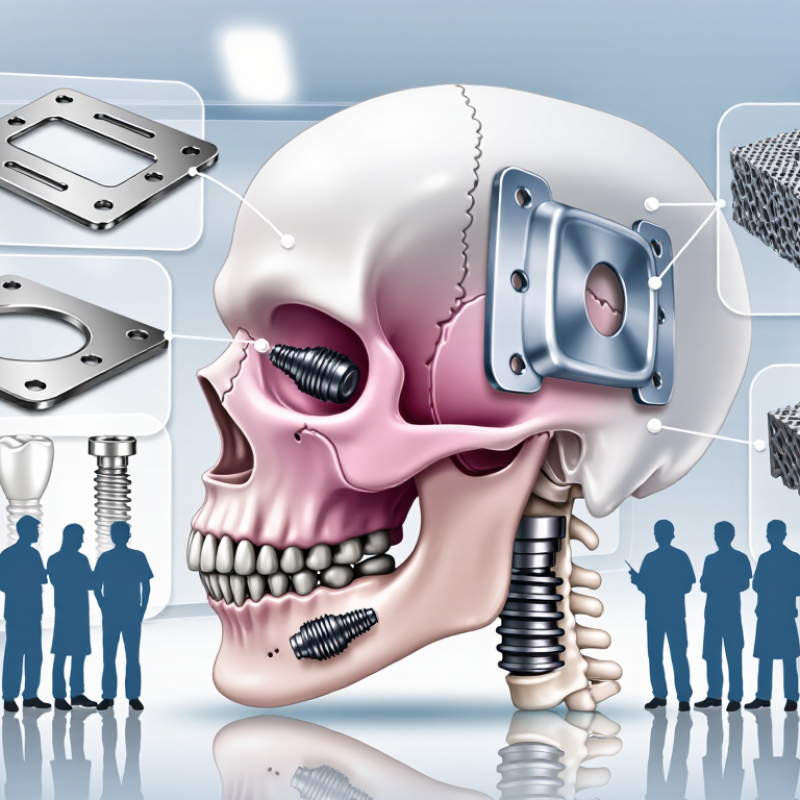
What Is the Best Alloy for Maxillofacial Reconstruction?

What Alloys Do in Maxillofacial Reconstruction

What Is the Best Alloy for Maxillofacial Reconstruction?

What Alloys Do in Maxillofacial Reconstruction

Alloys do more than hold bone in place. They manage load, corrosion, imaging, and tissue response. Titanium alloy remains widely selected because its density is about 4.5 g/cm³, nearly half that of cobalt-chromium alloys. This reduces the weight of plates around the orbit and midface. ISO 5832-3 and ASTM F136 define key requirements for titanium alloy composition, strength, and impurities.

Mechanical strength matters when chewing forces reach a reconstruction site. Cobalt-chromium alloys offer higher stiffness and wear resistance, but they are heavier. Their elastic modulus also differs greatly from bone. That mismatch may concentrate stress around screws. A 2022 systematic review in the Journal of Cranio-Maxillofacial Surgery reported reconstruction-plate complications ranging from approximately 5% to 30% across studies. The variation reflected anatomy, radiation exposure, infection, and follow-up time. Alloy choice alone did not explain failure.

Not every case needs the strongest metal. That assumption deserves caution. Titanium’s oxide layer supports corrosion resistance, while its lower density can improve comfort and imaging conditions. Tantalum offers excellent porosity for bone ingrowth, yet its cost and handling requirements limit routine use. The American Society for Testing and Materials and the AO Foundation both emphasize design, fixation, and surgical technique alongside material selection. In practice, a thin plate may fail from poor contouring, not weak alloy. That is an uncomfortable detail. Surgeons should match alloy behavior with bone quality, defect size, radiation history, and planned loading.

What Is the Best Alloy for Maxillofacial Reconstruction?

Titanium alloys are often preferred for maxillofacial reconstruction because they combine low density, relatively low elastic modulus, high corrosion resistance, and good biocompatibility. Cobalt–chromium, stainless steel, and tantalum can provide excellent strength or special clinical benefits, but they are generally denser and stiffer. The values shown are representative engineering properties; exact results vary with composition, manufacturing process, and heat treatment.

Key Requirements for a Maxillofacial Reconstruction Alloy

What Is the Best Alloy for Maxillofacial Reconstruction?

The best alloy must balance strength, tissue compatibility, weight, and imaging performance. Titanium alloys remain strong candidates because their density is about 4.5 g/cm³, nearly half that of cobalt-chromium alloys. This matters when a patient carries a large mandibular plate near thin soft tissue. Titanium also resists corrosion in saliva and blood. However, its elastic modulus remains higher than cortical bone, which may affect load transfer.

Key Requirements for a Maxillofacial Reconstruction Alloy

Mechanical reliability should be measurable, not assumed. ASTM F136 specifies minimum tensile strength of 860 MPa and yield strength of 795 MPa for titanium alloy Ti-6Al-4V ELI. These figures support demanding fixation, but they do not predict every clinical outcome. The FDA’s ISO 10993-1 guidance requires a biological safety assessment based on contact type and duration. Imaging compatibility also matters. Lower artifact production can help surgeons evaluate bone healing around the reconstruction. A 2023 systematic review in the International Journal of Oral and Maxillofacial Surgery reported generally favorable outcomes for titanium reconstruction systems, while noting inconsistent complication definitions. That limitation deserves attention.

Tips: Match alloy stiffness to the defect, not only the load. Check fatigue data, surface treatment, and sterilization effects. Ask for traceable ASTM or ISO test results. A thinner plate may feel elegant, yet fatigue failure remains possible. Clinical judgment still matters more than a single strength number.

Titanium Alloys: Benefits, Applications, and Limitations

When surgeons assess complex facial defects, titanium alloys are frequently favored for reconstruction. Their strength-to-weight ratio supports stable fixation without excessive bulk. A thin plate can stabilize fractured bone while limiting pressure on nearby soft tissue. This matters around the orbit, jaw, and midface, where millimeters affect function and appearance. Titanium also forms a stable oxide layer, supporting corrosion resistance and tissue compatibility. These properties explain its established use in fixation plates, cranial meshes, patient-specific implants, and reconstruction frameworks.

Clinical selection requires more than material strength. Teams review defect size, bone quality, soft-tissue coverage, occlusion, imaging needs, and possible revision surgery. Intraoperative handling matters too. Titanium can be contoured, but repeated bending may weaken a plate. Poor adaptation can leave palpable edges or create stress concentrations. Porous designs may encourage bone ingrowth, yet they can complicate cleaning when infection develops. Experienced surgeons often work with engineers and radiologists before fabrication, although planning is not always perfect.

Titanium alloys still have limitations. Their stiffness differs from bone, which may alter load transfer and contribute to stress shielding. MRI concerns are usually manageable, but artifacts can obscure nearby anatomy. Manufacturing time and cost may challenge urgent treatment. Titanium is not automatically the best alloy. The choice depends on anatomy, biology, imaging, and surgical experience. I would question confident claims of permanent superiority. Long-term follow-up remains important, especially for growing patients and contaminated wounds.

Alternative Alloys Used in Facial Bone Reconstruction

Choosing the best alloy for maxillofacial reconstruction is rarely a simple ranking exercise. The defect’s location, load, soft-tissue cover, and imaging needs can change the decision. Titanium alloys remain common because they combine low weight, corrosion resistance, and useful strength. Yet alternatives deserve careful attention when titanium is not ideal for a patient or design.

Cobalt-chromium alloys provide high stiffness and wear resistance. They may suit small, load-bearing components, but their rigidity can transfer stress to surrounding bone. Stainless steel is affordable and familiar in temporary fixation. Its long-term use requires careful review of corrosion behavior, nickel content, and allergy history. Nickel-titanium offers shape-memory behavior, which can help in specialized devices, although temperature response and fatigue performance complicate planning. The evidence varies.

Porous tantalum is not technically an alloy, but it remains relevant to this discussion. Its open structure can encourage bone ingrowth, while its density may increase implant weight. Fit still matters. Material selection should involve a maxillofacial surgeon, biomedical engineer, radiologist, and dental specialist. They should compare CT artifacts, sterilization, fixation, and the patient’s healing risks. Laboratory data cannot predict every facial movement or wound problem. A material can perform well on paper and still fail when contour, infection, or thin tissue changes the environment. Long-term follow-up remains essential, especially when evidence comes from small studies.

How Surgeons Choose the Most Suitable Alloy by Case

What Is the Best Alloy for Maxillofacial Reconstruction?

How Surgeons Choose the Most Suitable Alloy by Case

There is no universal best alloy for maxillofacial reconstruction. Titanium alloys are often selected because they are lightweight, strong, and generally well tolerated by bone and soft tissue. They can also create fewer imaging artifacts than stainless steel. This matters when surgeons review postoperative CT scans. Yet titanium is not automatically the correct answer.

Case details guide the decision. A patient needing orbital floor repair may require a thin, precisely shaped material. Someone with a large mandibular defect may need greater structural strength and reliable fixation. Surgeons also assess bone quality, bite alignment, infection history, previous radiation, and expected facial growth. Dental function matters too. A plate that looks stable on a scan may still interfere with future implants or occlusion.

Cobalt-chromium alloys can offer high strength and wear resistance, but they are heavier and may complicate imaging. Stainless steel remains useful in selected temporary or rigid fixation applications, although corrosion concerns and artifact levels require careful assessment. Patient-specific design can improve fit, but manufacturing accuracy does not replace surgical judgment. A neat rule can fail. Material choice should involve the reconstructive surgeon, radiologist, biomedical specialists, and dental team. Even then, tissue response and healing remain partly unpredictable. That uncertainty deserves honest discussion before surgery.

What Is the Best Alloy for Maxillofacial Reconstruction? — How Surgeons Choose the Most Suitable Alloy by Case
Material Typical Density Elastic Modulus Typical Mechanical Profile Biological and Imaging Characteristics Common Maxillofacial Applications Key Advantages Important Limitations
Titanium Alloy
Ti-6Al-4V ELI
Approximately 4.4 g/cm³ Approximately 110–114 GPa High strength-to-weight ratio; typical minimum yield strength for implant-grade wrought material is about 795 MPa, depending on the applicable standard and processing route. Excellent corrosion resistance and generally favorable biocompatibility. Non-ferromagnetic, but it can still create some CT and MRI artifacts. Load-bearing fixation plates, screws, reconstruction frameworks, orbital rims, midface and mandibular reconstruction. Lightweight, strong, fatigue-resistant, widely used, and compatible with porous or textured surfaces designed to encourage bone integration. More difficult to contour than some softer metals; surface wear or fretting should be minimized in moving or contacting interfaces.
Titanium Alloy
Ti-6Al-7Nb
Approximately 4.5 g/cm³ Approximately 105–115 GPa High strength with a mechanical profile broadly comparable to other implant-grade alpha-beta titanium alloys. Strong passive oxide layer, high corrosion resistance, and generally favorable tissue response. Non-ferromagnetic with relatively limited imaging artifact compared with cobalt-chromium. Patient-specific craniofacial implants, fixation systems, orbital and zygomatic reconstruction, and cases where a titanium alternative is preferred. Low weight, good strength, good manufacturability for machining or additive manufacturing, and suitable stiffness for many craniofacial indications. Clinical performance depends strongly on implant design, surface treatment, porosity, and manufacturing quality rather than alloy chemistry alone.
Commercially Pure Titanium
Grades 1–4
Approximately 4.5 g/cm³ Approximately 102–105 GPa Lower strength than Ti-6Al-4V; strength increases from Grade 1 to Grade 4. Grade 4 is commonly selected when higher commercially pure titanium strength is needed. Excellent corrosion resistance and biocompatibility. Non-ferromagnetic and usually produces less imaging distortion than higher-density alloys. Low- to moderate-load components, meshes, membranes, thin cranial plates, and selected patient-specific implants. Very good corrosion resistance, low density, favorable biological response, and relatively low imaging artifact. Lower strength and fatigue capability than titanium alloys; may be unsuitable for heavily loaded mandibular reconstruction unless adequately designed.
Cobalt-Chromium-Molybdenum
Co-Cr-Mo
Approximately 8.3–9.2 g/cm³ Approximately 210–250 GPa Very high stiffness, wear resistance, and strength; exact values vary substantially with casting, forging, heat treatment, and additive-manufacturing conditions. Highly corrosion-resistant and generally non-ferromagnetic. Its high density and atomic number can produce more CT and MRI artifacts than titanium. Selected high-strength frameworks, complex load-bearing components, and situations requiring high rigidity or wear resistance. Excellent rigidity, strength, and resistance to deformation and wear. Heavier than titanium, stiffer than bone, more difficult to machine or contour, and more likely to interfere with postoperative imaging. Metal sensitivity is uncommon but clinically relevant when suspected.
316L Stainless Steel Approximately 7.9–8.0 g/cm³ Approximately 190–200 GPa Typical annealed yield strength is at least about 170 MPa; cold working can substantially increase strength. Good corrosion resistance when properly processed, but generally less corrosion-resistant than titanium or cobalt-chromium in demanding implant environments. Usually non-ferromagnetic in the annealed condition. Temporary fixation, selected fracture plates and screws, and situations where cost, availability, or established instrumentation is important. Widely available, familiar to surgeons, relatively economical, and straightforward to manufacture. Heavier and stiffer than titanium, greater imaging artifact than titanium, and less attractive for permanent implants when long-term corrosion performance or low weight is a priority.
Tantalum
Porous or Solid
Approximately 16.6 g/cm³ for solid tantalum Approximately 186 GPa for solid tantalum; porous structures have a much lower effective stiffness. Solid tantalum is strong and ductile; porous tantalum is selected primarily for its interconnected structure rather than for maximum bulk strength. Excellent corrosion resistance and favorable bone ingrowth potential in appropriately designed porous structures. High density can increase imaging artifacts and implant weight. Selected revision, salvage, and complex bone-defect reconstructions where three-dimensional porous bone ingrowth and structural support are important. Porous architecture can support bone ingrowth and improve fixation in challenging defects; highly resistant to corrosion. High material cost, high density, limited contourability, and potentially greater imaging artifact. Use is generally reserved for carefully selected complex defects.

How surgeons choose: The most suitable alloy depends on defect location, expected loading, implant geometry, bone quality, need for contouring or patient-specific manufacturing, infection or revision risk, postoperative imaging requirements, and the patient’s allergy or sensitivity history. Mechanical values are typical reference ranges and can vary with alloy grade, product standard, heat treatment, surface finish, and manufacturing method.

FAQS

What makes titanium alloy a common choice for maxillofacial reconstruction?

Titanium alloy weighs about 4.5 g/cm³, nearly half the density of cobalt-chromium alloys. This lighter weight can improve comfort near the orbit and midface. It also resists corrosion in saliva and blood. Still, it is not automatically ideal.

Is the strongest alloy always the best option?

No. Higher stiffness may concentrate stress around screws when it differs greatly from bone. Cobalt-chromium alloys offer strong wear resistance but add weight. Stronger is not always kinder.

How should alloy stiffness match the reconstruction site?

Surgeons should consider bone quality, defect size, and expected chewing forces. A very stiff plate can transfer loads unevenly. A flexible design may fatigue under repeated movement. The balance is difficult.

Does alloy choice alone determine reconstruction success?

No. Complication rates have varied from about 5% to 30% across clinical studies. Radiation exposure, infection, anatomy, and follow-up time also affect outcomes. The metal rarely works alone.

Can a thin reconstruction plate fail?

Yes. Poor contouring can create failure even when the alloy has high strength. Repeated chewing produces many small loading cycles. A thin plate may look elegant. That judgment can be wrong.

What benefit can tantalum provide?

Tantalum can offer a porous structure that encourages bone ingrowth. Its cost and handling requirements may limit routine use. It suits selected situations, not every patient.

Why does imaging performance matter?

Lower imaging artifacts can help clinicians inspect bone healing around the reconstruction. This matters near the orbit, jaw, and other detailed structures. Clearer images can support better follow-up decisions.

What alloy information should clinicians review before selection?

They should check fatigue data, surface treatment, sterilization effects, and biological safety evidence. Traceable mechanical test results are useful. Strength numbers alone cannot predict clinical success. That limitation deserves reflection.

Conclusion

Alloys play an important role in maxillofacial reconstruction by providing structural support, restoring facial contours, and helping protect delicate anatomical areas. An ideal alloy should combine strength, light weight, corrosion resistance, biocompatibility, and compatibility with imaging and surgical procedures. Titanium alloys are widely valued for their durability, relatively low density, tissue tolerance, and adaptability to plates, meshes, and patient-specific implants. However, their cost, manufacturing complexity, stiffness, and possible imaging-related limitations may require careful consideration.

Alternative materials, including cobalt-based and other specialized metallic alloys, may be selected when particular mechanical or clinical properties are needed. The choice depends on the reconstruction site, defect size, required load-bearing capacity, soft-tissue condition, infection risk, patient health, imaging requirements, and the surgeon’s experience. Understanding how to select alloys for maxillofacial reconstruction allows the surgical team to balance stability, biological response, appearance, and long-term performance. Ultimately, alloy selection should be individualized through careful clinical assessment and collaboration among surgeons, engineers, and patients.

Isabella

Isabella

Isabella is a dedicated marketing professional with a sharp focus on driving brand growth and engagement through strategic content creation. With an extensive background in digital marketing, she combines her passion for storytelling with her keen understanding of industry trends to deliver......